PMN310
mAb (Intravenous)
Development progress
To view the webinar replay of “PRECISE-AD Phase 1b Blinded Interim Data Analysis" Click Here
Our robust intellectual property estate features more than 100 patents issued or pending covering disease-specific epitopes (targets) on misfolded proteins, together with antibody and vaccine candidates directed against them, across a range of neurodegenerative diseases.
Our proprietary EpiSelect™ Platform has enabled us to build a growing pipeline of clinical and pre-clinical candidates addressing some of the most intractable neurodegenerative diseases. Our pipeline aims to provide hope for the millions of people affected by these diseases.
mAb (Intravenous)
Development progress
mAb (Subcutaneous)
Development progress
mAb, Intrabody
Development progress
mAb
Development progress
Vaccine
Development progress
Vaccine
Development progress
Vaccine
Development progress
Development progress
Development progress
| Candidate | Primary Indication(s) | Target Protein | Discovery | Preclinical | Phase 1 | Phase 2 | Phase 3 |
|---|---|---|---|---|---|---|---|
| PMN310 mAb (Intravenous) | Early Alzheimer's Disease | Amyloid-Beta |
|
||||
| PMN310 mAb (Subcutaneous) | Early Alzheimer's Disease | Amyloid-Beta |
|
||||
| PMN267 mAb, Intrabody | Amyotrophic Lateral Sclerosis (ALS) Frontotemporal Dementia (FTD) |
TDP-43 |
|
||||
| PMN442 mAb | Parkinson's Disease (PD) Dementia with Lewy Bodies (DLB) Multiple System Atrophy (MSA) |
Alpha-Synuclein |
|
||||
| PMN311 Vaccine | Alzheimer's Prevention | Amyloid-Beta |
|
||||
| PMN260 Vaccine | TDP-43 Proteinopathies | TDP-43 |
|
||||
| PMN440 Vaccine | Alpha-Synucleinopathies | Alpha-Synuclein |
|
||||
| DISCOVERY | ALS, FTD | RACK1 |
|
||||
| DISCOVERY | Schizophrenia | DISC1 |
|
||||
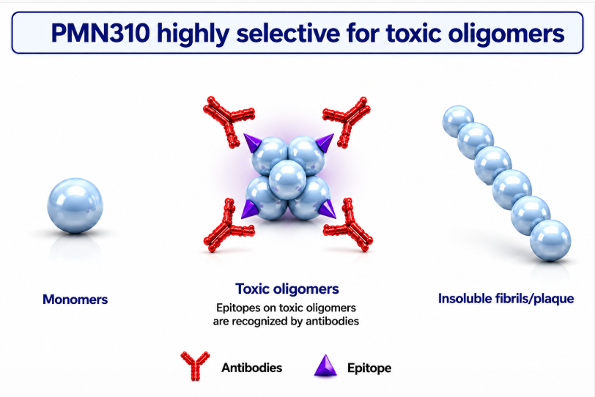
PMN310, a potential best in class, next generation therapeutic, is an investigational monoclonal antibody designed to selectively target toxic oligomers of amyloid-beta (AβOs), which are widely recognized as a major driver of Alzheimer’s disease.
By specifically targeting AβOs, PMN310 aims to avoid off-target binding, which may provide greater efficacy, fewer ARIA (Amyloid-Related Imaging Abnormalities) events, and more convenient dosing.
Preclinical studies suggested that PMN310 could selectively neutralize toxic AβOs and protect cognition. We have completed a single ascending dose Phase 1a clinical trial in normal healthy volunteers, which demonstrated good tolerability across the dose range tested and confirmed PMN310’s ability to cross the blood-brain barrier at levels well in excess of target oligomer concentrations, supporting potential once-per-month dosing.
We are currently conducting a randomized, double-blind, placebo-controlled Phase 1b clinical trial (NCT06750432) of 12 repeat monthly doses of intravenous PMN310 to assess its safety, tolerability, pharmacokinetics and preliminary efficacy in participants with early Alzheimer’s Disease. The PRECISE-AD trial is now fully enrolled (n=144). Trial readouts are anticipated following 6- and 12-month data analyses.
We have received Fast Track designation from the U.S. Food & Drug Administration for the development of PMN310 in Alzheimer’s disease.
PMN267 is our lead candidate targeting misfolded TDP-43 (TAR DNA-binding protein 43), which is present and implicated in both Amyotrophic Lateral Sclerosis (ALS) and Frontotemporal Dementia (FTD) cases.
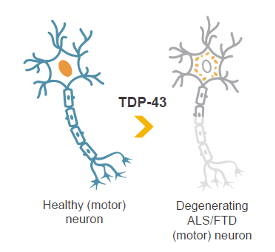
PMN267 is a monoclonal antibody (mAb) that has been shown in preclinical studies to selectively bind to toxic misfolded TDP-43, avoiding normal physiologic TDP-43, and to inhibit cell-to-cell propagation of toxic misfolded TDP-43 to hinder disease progression.
PMN267 has been humanized in a human IgG1 framework for IND-enabling studies.
An intrabody version of PMN267 (PMN270) delivered intracellularly was found to selectively target cytoplasmic aggregates of TDP-43 without interfering with normal TDP-43 function, representing another avenue of intervention for ALS/FTD.
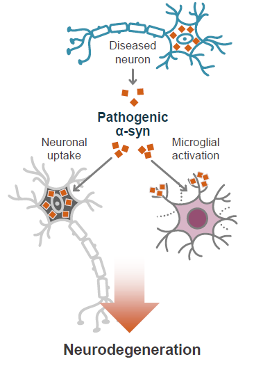
Our lead antibody candidate targeting misfolded alpha-synuclein (α-syn) is PMN442. When α-syn misfolds, it clumps into toxic aggregates that have been implicated in Parkinson’s Disease (PD), Dementia with Lewy bodies (DLB), and Multiple System Atrophy (MSA).
PMN442 has shown selectivity for pathogenic species of α-syn over non-toxic monomers and physiologic tetramers in preclinical studies. It has also demonstrated protection of neurons against killing by α-syn toxic oligomers and cell to cell propagation of toxic aggregates.
PMN442 has been humanized in a human IgG1 framework for IND-enabling studies.
Epitopes of toxic misfolded proteins identified by the ProMIS platform can also be used for direct vaccination of individuals to induce production of selectively protective antibodies.
Lead vaccine compositions and formulations have been selected for an Aβ oligomer vaccine against AD (PMN311) and an α-syn vaccine against synucleinopathies (PMN440) based on mouse vaccination studies.
A vaccine program is also underway (PMN260) targeting TDP-43, maximizing a selective approach that we believe could mitigate the risk of T cell inflammatory response in the CNS.
RACK1 Program: RACK1 is a scaffold protein critical for cell function and proliferation. Study of its interaction with TDP-43 has revealed its potential as a new target for ALS and other TDP-43 proteinopathies.
DISC1 Program: We are exploring DISC1, a scaffold protein involved in neuronal functions, as a potential target of interest in the treatment of schizophrenia and other major mental illnesses.
Our scientific expertise is backed by decades of research on protein misfolding diseases such as AD, MSA, ALS, and PD. We encourage you to visit our scientific library to learn more about our programs.
View Posters & Publications